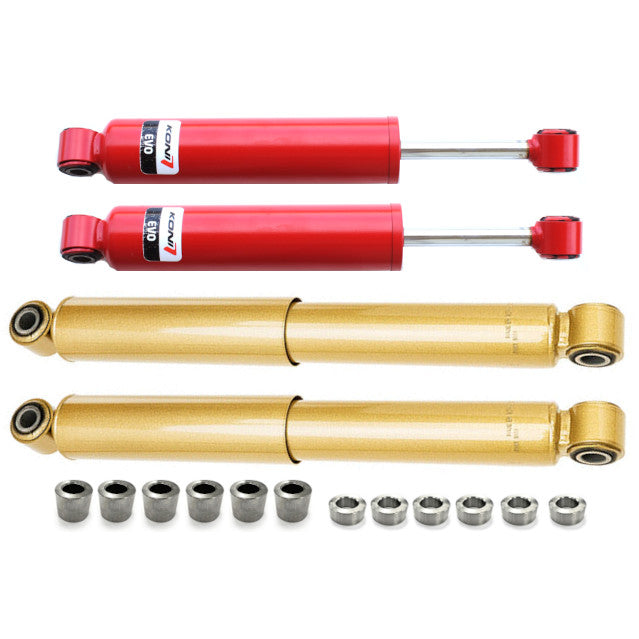
KONI FSD Gold
Frequency Selective Damping is designed to balance ride comfort with body control. It responds differently to varying suspension frequencies and does not require the driver to make adjustments.
Motorhome Shock Guide
Learn how KONI motorhome shocks work, compare the available shock families, and find the correct application for your chassis and axle position.
A motorhome shock absorber controls suspension movement after the tires and springs react to a bump, dip, bridge joint, or other road input. Better damping can reduce repeated bouncing, porpoising, and excess body movement without changing the motorhome's load capacity.
KONI offers more than one shock design for motorhome applications. The correct option depends on the chassis and the part number available for that specific front or rear axle.
Frequency Selective Damping is designed to balance ride comfort with body control. It responds differently to varying suspension frequencies and does not require the driver to make adjustments.
EVO 99 is a heavy-duty motorhome shock offered for select applications where a large damper and strong control are needed. Availability is chassis- and axle-specific.
Some KONI motorhome applications use adjustable rebound damping. Adjustment procedures vary by part number, so follow the instructions supplied with the shock.
Use the table below to open the closest KONI application guide. Some rows are organized by chassis manufacturer, while others use the coach brand because that is how owners commonly identify the motorhome.
Two coaches with the same brand name can use different chassis or chassis model years. Confirm the chassis identification label and whether you are replacing front or rear shocks.
| Chassis or Coach Brand | Guide Type | KONI Shock Guide |
|---|---|---|
| Alpine | Coach brand | View Alpine guide |
| Beaver | Coach brand | View Beaver guide |
| Blue Bird Wanderlodge | Coach brand | View Wanderlodge guide |
| Chevrolet | Chassis manufacturer | View Chevrolet guide |
| Country Coach | Coach brand | View Country Coach guide |
| Dodge and Ram | Chassis manufacturer | View Dodge and Ram guide |
| Featherlite | Coach brand | View Featherlite guide |
| Ford | Chassis manufacturer | View Ford guide |
| Foretravel | Coach brand | View Foretravel guide |
| Freightliner | Chassis manufacturer | View Freightliner guide |
| GMC | Chassis manufacturer | View GMC guide |
| Magnum | Chassis family | View Magnum guide |
| MCI | Bus platform | View MCI guide |
| Monaco | Coach brand | View Monaco guide |
| Prevost | Bus and chassis platform | View Prevost guide |
| Roadmaster | Chassis family | View Roadmaster chassis guide |
| Safari | Coach brand | View Safari guide |
| Spartan | Chassis manufacturer | View Spartan guide |
| Mercedes-Benz Sprinter | Chassis platform | View Sprinter guide |
| Tiffin | Coach brand | View Tiffin guide |
| Workhorse | Chassis manufacturer | View Workhorse guide |
| What You Feel | Where Shocks May Help | What Else to Inspect |
|---|---|---|
| Repeated bouncing after a dip | Shocks control repeated suspension movement and may reduce the number of rebound cycles. | Springs, ride height, tire pressure, and worn mounts |
| Front-to-rear porpoising | Better damping can reduce the pitching motion that continues after bridge joints and rolling pavement. | Weight distribution, wheelbase, springs, and front-to-rear shock condition |
| Body roll in turns | Shocks can help control the speed of body movement. | Anti-sway bars, bushings, weight distribution, and ride height |
| Steering wander or play | Shocks are not the primary correction for steering looseness. | Alignment, steering linkage, bell cranks, steering stabilizer, tires, and rear axle movement |
| Rear sag or low ride height | Standard shocks do not carry vehicle weight or restore ride height. | Springs, air springs, suspension damage, axle weight, and GVWR limits |
Use the chassis manufacturer and chassis model year, not only the model year printed on the coach title.
Front and rear shocks usually use different part numbers. Tag-axle applications may require another position-specific part.
Check tires, alignment, mounts, bushings, springs, and steering components so another problem is not mistaken for worn shocks.
No. KONI fitment depends on the chassis, chassis model year, suspension configuration, and axle position. Always verify the application before ordering.
Use the chassis model year for shock fitment. The chassis may have been built before the completed motorhome's titled model year.
They may help control the speed of body movement, but excessive sway can also involve anti-sway bars, worn bushings, tire pressure, weight distribution, or ride height.
No. Standard shock absorbers control motion but do not support vehicle weight. Sagging requires inspection of the springs, air suspension, ride height, loading, and axle weight.
Yes. Replace both shocks on the same axle so damping remains balanced from side to side. Inspect the other axle at the same time.
Use the vehicle selector with the chassis information and axle position. Contact Motorhome Shocks & More if two applications appear similar.
Start with the chassis manufacturer, chassis model year, and axle position. Call us when the chassis tag or application is unclear.