

Cart

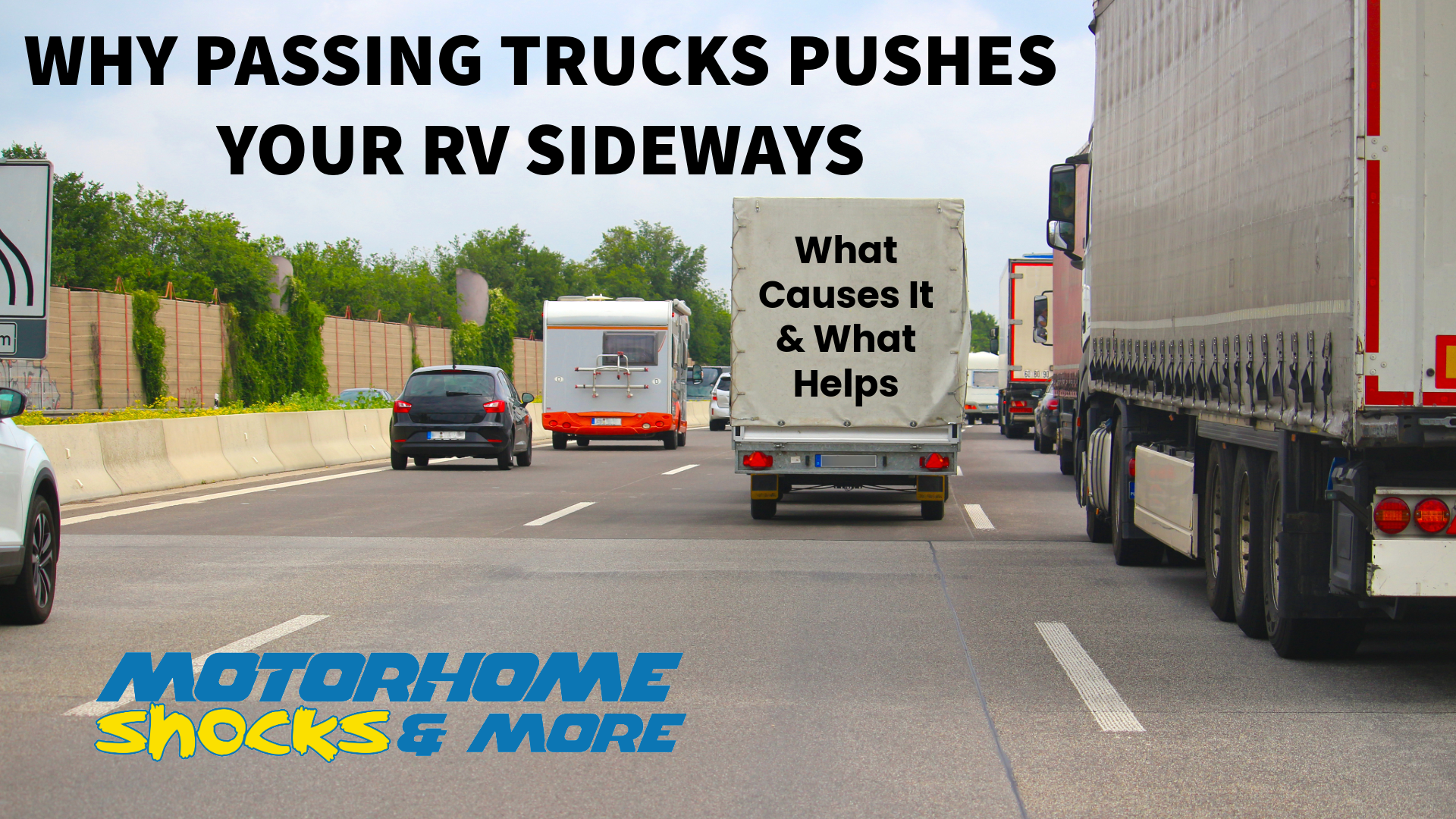
Why Your RV Feels Pushed Around by Passing Trucks
If your RV feels like it gets shoved sideways whenever a tractor-trailer passes, you're not imagining it. It's one of the most common highway handling complaints among motorhome owners. Few driving situations raise your stress level faster than feeling the coach move while you're already watching traffic and lane position.
Owners often describe the entire experience as their RV being pushed by passing trucks. However, several forces and vehicle movements can occur simultaneously. The truck changes the airflow and pressure around your RV. Your motorhome can then respond with steering movement, body roll, axle movement, or continued suspension motion.
That's why the right solution isn't simply to drive more slowly or buy a single suspension part. Some of what you're feeling is unavoidable aerodynamics. The rest depends on how well your motorhome controls the disturbance after it reaches the chassis.
This guide explains why passing trucks push an RV sideways, why some motorhomes react more strongly, and which upgrades can improve highway stability. You can also browse Motorhome Shocks & More and the RV Performance blog for additional symptom-based suspension guidance.
What Happens When a Large Truck Passes Your RV?
A large truck changes the air around both vehicles as it approaches, moves alongside your RV, and pulls ahead. Those changing pressure patterns and wake turbulence can create rapidly changing lateral forces on a motorhome.
From the driver's seat, the result may feel like a push, pull, or combination of both. The exact sensation depends on vehicle speed, spacing, wind direction, lane position, and the shapes of both vehicles.
Motorhomes can be particularly sensitive because they often have:
- A large side surface exposed to moving air
- A tall body that gives side forces more leverage
- A relatively high center of gravity
- Suspension and steering systems that must control substantial vehicle weight
- Long rear overhangs on some chassis and body configurations
The truck creates the aerodynamic disturbance, but your RV determines how much movement follows. A well-controlled coach may move slightly and settle quickly. A coach with excessive body roll, axle movement, steering sensitivity, or weak damping may continue reacting after the truck has passed.
Why Do Some Motorhomes React More Than Others?
Two RVs can travel through the same traffic and respond very differently. Vehicle design, loading, tire setup, chassis condition, and suspension control all affect how noticeable the disturbance becomes.
Large Side Area and Vehicle Height
A tall motorhome presents a large surface to crosswinds and changing airflow. That gives passing-truck pressure changes more area to act against. Vehicle height can also make body roll more noticeable when a sideways force reaches the coach.
Wheelbase and Rear Overhang
Wheelbase can influence straight-line stability, but it isn't the only dimension that matters. Rear overhang, body length, weight placement, and suspension design also affect how quickly the coach responds and settles.
Tire Pressure and Loaded Weight
Tire setup can have a major effect on handling. Pressures that don't properly support the actual load can affect steering response, stability, tire wear, and ride quality.
For the best information, weigh the motorhome in its normal travel configuration. Individual wheel-position weights are especially useful when available. Then use the tire manufacturer's load and inflation information and follow applicable chassis requirements.
Michelin provides a useful RV load and inflation guide for owners using compatible Michelin tires.
Body Roll
If the motorhome leans heavily when a side force hits it, the passing truck can feel much more dramatic. The aerodynamic event may be brief, but excessive roll can make the body continue moving afterward.
Weak Suspension Damping
Shocks don't stop the original aerodynamic force. Their job is to control suspension movement after the chassis has been disturbed. Worn or poorly matched shocks can allow rocking, pitching, or bouncing to continue longer than they should.
Lateral Axle Movement
Some solid-axle motorhome chassis can experience unwanted side-to-side axle movement relative to the frame. When that happens, the rear of the coach may feel loose, delayed, or as though it's helping steer the motorhome.
This sensation is often described as tail wag or rear steer. A properly fitted trac bar can help limit that unwanted lateral axle movement.
Normal Passing-Truck Movement vs. a Handling Problem
Even a well-sorted motorhome will feel some effect when a large truck passes at highway speed. Suspension upgrades can't make a tall RV immune to aerodynamic forces.
The important difference is how strongly the motorhome reacts and how quickly it recovers.
| More Normal Response | Possible Handling Problem |
|---|---|
| You notice the truck's airflow | The coach gets moved sharply off its intended path |
| A small steering correction is needed | Several steering corrections are needed |
| The coach settles quickly | The body keeps rocking after the truck passes |
| The rear feels connected to the chassis | The rear feels loose or delayed |
| Traffic requires attention but remains manageable | Passing traffic creates significant driver fatigue |
If every passing truck triggers a chain of steering corrections and body movements, the aerodynamic pressure may be exposing an existing suspension or steering weakness.
What Helps When Passing Trucks Push Your RV Sideways?
The best upgrade depends on what the motorhome does after the truck's airflow reaches it. Shocks, anti-sway bars, trac bars, and steering stabilizers all perform different jobs.
Shocks for Continued Motion
Shock absorbers control suspension compression and rebound. They help the motorhome settle after bumps, dips, wind disturbances, and other inputs.
Shocks deserve attention when the coach feels:
- Floaty after a disturbance
- Slow to settle
- Bouncy after bridge joints or dips
- Prone to repeated rocking or pitching
- Generally under-controlled on uneven highways
Better shocks won't prevent a passing truck from changing the airflow around your RV. They can help reduce the subsequent suspension movement.
Anti-Sway Bars for Excessive Body Roll
An anti-sway bar connects the left and right sides of the suspension and resists excessive body roll. This makes it especially relevant when the coach leans strongly during crosswinds, turns, ramps, or passing-truck events.
If the truck's pressure wave causes the entire body to lean sharply to one side before recovering, sway control should be part of the inspection.
You can learn more about these different types of movement in the Motorhome Shocks guide to reducing RV sway.
Trac Bars for Side-to-Side Axle Movement
A trac bar connects the axle and chassis to limit unwanted lateral axle movement. This can be especially useful when the rear of a motorhome feels loose, delayed, or pushed sideways before the rest of the coach responds.
A trac bar may deserve attention when:
- Passing trucks seem to move the rear of the coach sideways
- The RV feels like it's steering from behind
- The rear responds later than the front
- Tail wag is more noticeable than vertical bounce
- The axle appears to move laterally relative to the chassis
The Roadmaster TruTrac bar guide explains how front trac bars control lateral axle movement on compatible chassis. Rear trac bars use the same basic principle at the rear axle when an application calls for one.
Steering Stabilizers for Steering-Wheel Reaction
A steering stabilizer focuses on unwanted steering movement. Depending on the design, it may provide damping, centering assistance, or both.
This upgrade often makes sense when the passing-truck complaint is mostly felt through the steering wheel. The driver may notice rapid corrections, excessive wheel movement, rut tracking, or increased effort during crosswinds.
A stabilizer won't replace an alignment or repair worn steering components. The steering wandering vs. soft steering guide can help separate steering complaints from broader suspension movement.
Which Upgrade Matches the Way Your RV Moves?
| What You Feel | Likely Area to Inspect | Upgrade to Consider |
|---|---|---|
| The coach keeps bouncing or rocking | Suspension damping | Shocks |
| The body leans heavily when the truck passes | Roll control | Anti-sway bar |
| The rear shifts sideways or feels delayed | Lateral axle control | Trac bar |
| The steering wheel feels busy or reactive | Steering control | Steering stabilizer |
| The coach pulls or wanders constantly | Tires, alignment, steering, suspension | Inspect before upgrading |
Several symptoms can happen at once. A motorhome may need more than one correction, but that doesn't mean every suspension component should be replaced automatically.
Check the Basics Before Buying Suspension Parts
Suspension upgrades work best when the underlying motorhome is already in good mechanical condition. Don't use an aftermarket part to hide a tire, alignment, steering, or loading problem.
A sensible starting sequence is:
- Confirm the motorhome's loaded weight. Weigh it in the condition you normally travel.
- Verify tire pressure. Follow the applicable chassis guidance and the tire manufacturer's load and inflation information.
- Inspect the tires. Look for damage, unusual wear, age-related deterioration, or mismatched tires.
- Check steering and suspension components. Repair worn joints, bushings, links, mounts, or other damaged parts.
- Verify alignment. Correct alignment problems before expecting a steering upgrade to solve wandering.
- Identify the strongest remaining symptom. Determine whether you're dealing with bounce, roll, axle shift, or steering reaction.
- Confirm chassis-specific fitment. Match every upgrade to the exact chassis, year, weight range, and required mounting hardware.
Driving Techniques That Can Help When Passing Trucks
Mechanical upgrades can improve control, but driving technique still matters. The goal is to anticipate the disturbance without creating additional movement through overcorrection.
Expect the Airflow Change
When you see a large truck approaching from behind, expect the steering and body to react. Knowing that a pressure change is coming makes it less startling.
Use Smooth Steering Inputs
A sudden correction followed by an equally sudden correction in the opposite direction can make the coach feel worse. Keep both hands available and use measured steering inputs.
Reduce Speed When Conditions Require It
Strong winds, heavy truck traffic, and rough pavement can combine to create a much more demanding driving situation. Reducing speed when it's safe to do so can lower aerodynamic loading and give you more time to react.
Maintain Safe Lane Position and Following Distance
Stay predictable and centered in your lane. Give surrounding traffic plenty of space, and avoid making sudden movements simply because a truck is approaching.
Pay Attention to Handling Outside of Truck Traffic
If the coach also wanders, rolls, bounces, or feels loose when no trucks are nearby, the problem probably isn't aerodynamics alone. That's a strong reason to inspect the chassis before blaming every sideways movement on passing traffic.
What Won't Fix Passing-Truck Problems by Itself?
One suspension part can't correct every movement involved in a passing-truck event.
- A steering stabilizer won't replace worn shocks.
- Shocks won't resist body roll like an anti-sway bar.
- An anti-sway bar won't locate an axle like a trac bar.
- A trac bar won't correct poor alignment.
- No upgrade can compensate for unsafe tires or overloaded axles.
That doesn't mean you need every available upgrade. It means the part should match the movement you're trying to control.
Which Motorhomes Are Most Sensitive to Passing Trucks?
Gas Class A Motorhomes
Gas Class A motorhomes are common candidates for handling upgrades because of their tall bodies, large side area, and heavy chassis. Depending on the complaint, owners may benefit from improved shocks, anti-sway bars, trac bars, or steering control.
Ford F53 owners can review the Ford F53 suspension upgrade guide for chassis-specific context.
Class C Motorhomes
Class C motorhomes can also react strongly to passing traffic. Wheelbase, rear overhang, body size, loading, tires, alignment, and suspension condition all affect highway behavior.
Ford E-Series Class C owners can also review the Ford E450 motorhome suspension upgrade guide.
Sprinter-Based Motorhomes
Sprinter-based RVs are smaller than many gas Class A coaches, but their tall body profiles can still make crosswinds and passing traffic noticeable. The correct solution depends on the exact Sprinter chassis, motorhome configuration, loaded weight, and dominant handling symptom.
What Improvement Should You Realistically Expect?
A better-sorted motorhome should still react when a large truck passes. The goal isn't to eliminate physics. It's to reduce the severity of the movement and the time it takes the RV to settle.
Depending on the original problem and the upgrades involved, you may notice:
- Less body roll when a truck passes
- Fewer steering corrections
- A more planted rear axle
- Faster recovery after a disturbance
- Less rocking after the initial airflow change
- Lower driver fatigue during long interstate trips
Those changes can make a significant difference on a long travel day, even though you'll still notice strong winds and heavy trucks nearby.
Fix the Movement, Not Just the Symptom
When passing trucks push your RV sideways, the truck is only part of the story. The other part is how your motorhome responds after the air pressure changes and turbulence reaches the coach.
If the RV keeps bouncing or rocking, inspect the shocks. If the body leans heavily, look at sway control. If the rear shifts sideways, investigate lateral axle control. If the steering wheel feels unusually busy, a steering stabilizer may deserve attention.
Before purchasing anything, verify loaded weight, tire pressure, alignment, steering condition, and chassis-specific fitment. That symptom-first approach helps you spend money on the component that actually addresses the movement you're feeling.
When you're ready to narrow down the right solution, browse Motorhome Shocks & More, explore the RV Performance guides, and compare upgrades based on how your specific motorhome handles on the highway.


